When you think of the Fantastic Four, your mind probably jumps to Reed stretching, Sue disappearing, Johnny flaming on, or Ben smashing. But before the powers, the cosmic rays, or even the fantastic adventures, there was a symbol: the iconic "4." It's a glyph that instantly signifies Marvel's First Family, a beacon of science, exploration, and familial bonds. Yet, this symbol isn't just a corporate design asset; it's a creative canvas, constantly reimagined and celebrated in Fan Art & Unofficial Interpretations of the Fantastic Four Logo. From subtle homages to radical reboots, the fan community has taken this simple number and infused it with endless personality, proving that true iconography transcends its original creator.
At a Glance: Decoding the Fantastic Four Logo's Fan Appeal
- The "4" is an Enduring Icon: It's one of the most recognizable symbols in comic history, known for its simplicity and versatility.
- Official Evolution is Key: Understanding how the official logo changed over decades (fonts, colors, placement) provides context for fan creativity.
- Fan Art Isn't Just Copies: Unofficial interpretations range from direct homages to complete reimaginings, mashups, and parodies.
- Why Fans Do It: It's about creative expression, community engagement, filling perceived gaps, and deepening personal connections to the brand.
- Ethical Lines Exist: While fan art is generally welcomed, commercial use often crosses copyright boundaries, a crucial distinction.
- Your Turn to Create: You can interpret the "4" yourself by understanding its core elements and applying a personal, thematic twist.
The Fantastic Four: A Quick Cosmic Primer
Before diving into the intricate world of fan interpretations, it's essential to understand the foundation upon which this logo stands. The Fantastic Four aren't just any superhero team; they are Marvel's First Family, pioneers of the Silver Age, debuting in "The Fantastic Four #1" in 1961. Created by the legendary Stan Lee and Jack Kirby, their origin story is steeped in the space race era, with Reed Richards, Sue Richards, Johnny Storm, and Ben Grimm embarking on a scientific mission that exposed them to cosmic radiation.
This exposure granted them incredible, yet often challenging, powers: Reed became the stretchy Mr. Fantastic; Sue, the Invisible Woman, could generate force fields; Johnny ignited as the Human Torch; and Ben transformed into the rock-skinned Thing. What set them apart was their open identities and their portrayal as a loving, albeit frequently dysfunctional, family unit. Their adventures led them to face cosmic threats like Galactus and their arch-nemesis, Doctor Doom, cementing their place as cornerstones of the Marvel Universe. Their legacy is not just in their tales but in their enduring visual identity—a stylized glyph of the number 4—a testament to powerful branding.
The Iconic "4": Decoding a Design Legacy
At the heart of the Fantastic Four's brand identity, and the wellspring for countless unofficial interpretations, lies its symbol: the number 4. This simple numeral, often enclosed within a circle, has transcended mere typography to become an emblem of exploration, family, and the fantastic. Its journey through official comic book covers, animated series, and blockbuster films offers a rich tapestry of design choices that influence how fans perceive and recreate it. For a deeper dive into the official iterations, you might consult a comprehensive Fantastic Four logo guide.
The Enduring Core: Symbol and Colors
For over six decades, the "4" has been the unwavering anchor. While its precise rendering changed, the core concept — a glyph of the number 4 within a circle — remained paramount. Sometimes the "4" connects to the right side of the circle, other times it spreads across the entire space, but its presence is almost always felt.
Color, too, plays a crucial role. White and blue have been the dominant hues, a direct homage to the team's original costumes, suggesting intellect and stability. Yellow and red have also featured prominently, often hinting at the fiery presence of the Human Torch. Animated iterations occasionally ventured into purple and silver, demonstrating the adaptability of the core symbol even with unconventional palettes.
Font styles have varied, too, from robust grotesque styles that dominated for decades to more modern sans-serif blocky fonts. While avant-garde experiments occasionally popped up, they rarely stuck, underscoring a preference for clear, impactful readability. Recent comic logos have embraced a sharp, serif font, while cinematic versions lean towards sleek, minimalist sans-serifs, each attempting to balance history with contemporary aesthetics.
A Walk Through Time: Comic Logo Evolution
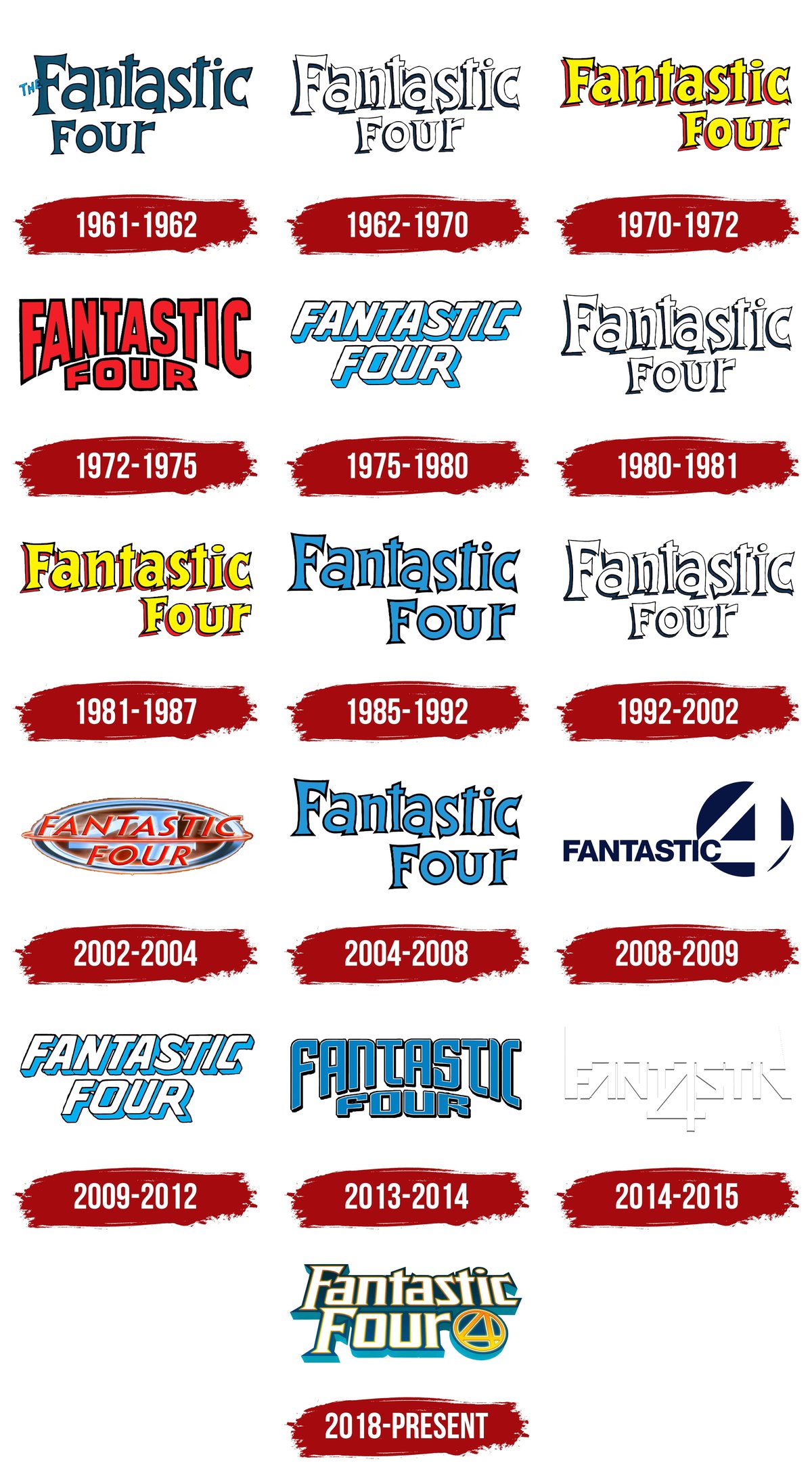
The Fantastic Four logo on comic books tells a story of evolving trends, character focuses, and artistic directions.
- 1961 – 1962: The Genesis of the Grotesque. The very first wordmark featured an uneven, bouncy grotesque-style font. "The" was present, minute and left-aligned, alongside "Fantastic" and "Four" in differing sizes. A dark blue color scheme, mirroring their costumes, grounded this inaugural design.
- 1962 – 1970, 1980 – 1981, 1992 – 2002 (Total 19 years): Inverting for Impact. This extended period saw the font largely retain its grotesque style, but a critical shift occurred: colors inverted to white letters with blue shadows. "The" was removed, centering the text and significantly boosting visibility and readability. This became a defining look for many.
- 1970 – 1972, 1981 – 1987 (Total 8 years): Fiery Focus. Keeping the established lettering style, the color scheme radically changed to bright yellow letters with red shadows. This vibrant choice reflected a heightened focus on the Human Torch during these periods, and the text shifted to right-alignment, making a bold statement.
- 1972 – 1975 (3 years): The Anti-Hero Arch. A stark departure, this logo used a blocky font curved along the X and Z-axes. "Fantastic" arched, with "Four" fitted beneath. A deep blood red with a black outline gave it an unexpectedly anti-heroic, edgy aesthetic for its time.
- 1975 – 1980, 2009 – 2012 (Total 8 years): Back to Basics, Futuristically. Designers embraced a return to three-dimensional, blocky, italicized letters, primarily in a blue and white palette. Center-aligned, this version felt modern and futuristic, a more grounded evolution after the experimental period.
- 1985 – 1992, 2004 – 2008: Refined Classicism. This iteration closely resembled the early '60s design but incorporated black-outlined letters and increased inter-character spacing. These subtle enhancements improved visual appeal and readability, making it a polished nod to the past.
- 1998: Hovering Logos and Character Focus. Briefly, a wordmark similar to the original font reappeared, often using shadowing to create a hovering effect. Another short-lived design placed character names directly above their symbol, emphasizing the individual heroes within the team.
- 2002 – 2004 (2 years): Striking, Yet Strained. This logo adopted a red and white color scheme, superimposed over a silver and dark scarlet team emblem background. The thin, italicized letters, while sleek, unfortunately proved difficult to read against the busy backdrop, limiting its lifespan.
- 2008 – 2009 (1 year): The Corporate "4." This plain, sans-serif wordmark controversially replaced "Four" with a bold number 4 representing the team emblem. Its dark navy blue color scheme gave it a corporate, almost generic appearance that clashed with the team's adventurous spirit, leading to its swift replacement.
- 2013 – 2014 (1 year): Retro-Round. Similar in arched shape to the 1972 design, this version featured softly rounded letters in the iconic blue color, a distinct departure from the "blood red." Despite its retro charm, it didn't quite align with contemporary aesthetic trends and had a short run.
- 2014 – 2015 (1 year): Experimental Futureshock. An ambitious, futuristic font spelled "FANTASTK," with a large, stylized number 4 boldly replacing the middle "A." Colored white with gray accents, this experimental design struggled to fuse the brand's rich history with a modern, almost abstract visual, quickly giving way to a new iteration.
- 2018 – Today: The Modern Classic. The current logo expertly balances six decades of history with modern design principles. It features white accents against a blue that darkens upward, creating depth. Crucially, the team emblem is subtly placed in a corner, adorned in a yellow that darkens to fiery orange, adding the Human Torch's signature vibrancy and combining successful elements from multiple variations.
Big Screen, Small Screen: Cinematic & TV Adaptations
The Fantastic Four's jump to other media brought its own set of design challenges and innovations, often reflecting the technological and stylistic trends of their respective eras.
- Early Days (Animated TV Series / Title Page): Character-Centric. Early animated iterations frequently showcased all four characters positioned in front of a large yellow number 4. "Fantastic" was typically presented in a straightforward sans-serif font above one half of the team, often contained within a clean white rectangle.
- 1967 – 1968 (Animated TV Series): Bold and Futuristic. This series featured a remarkably bold and enlarged number 4 set against a deep purple background. "Fantastic" appeared in a smaller, sans-serif wordmark, a design considered quite futuristic and impactful for its time.
- 1978 (Animated Series): Homage to the Original. This animation logo hearkened back to the earliest comic designs, utilizing an almost exact font, but colored in a bright red. Notably, "The" made a return, positioned at the top of the wordmark, a clear nod to the team's comic book roots.
- 1994 – 1996: Metallic and Sci-Fi. This era embraced a distinctly futuristic aesthetic, employing metallic-colored glyphs. It offered two versions of the team emblem: a silver double ring with the number 4 positioned to the left of the wordmark, and another appearing transparently behind the entire title. The background was a vibrant mix of celestial colors and sci-fi elements.
- 2005 (First Movie): Modern Separation. The inaugural Fantastic Four movie introduced a modern title screen where the iconic symbol literally separated the two words, "Fantastic" and "Four." It utilized a contemporary, metallic-edged color palette, signaling a fresh take for a new generation.
- 2006 – 2007: Animated Return to Roots. The animation logo from this period reverted to a font similar to the original comic typeface. The emblem now featured a single ring and was placed to the left. The color scheme was flat, dominated by purple and pale yellow, accented with white and red, a more minimalist animated approach.
- 2015 – Today (Cinematic Release): Sleek and Powerful. For the movie remake, the logo returned to metallic coloration, focusing on simplicity and impact. A notable departure was the replacement of the middle letter "A" with the number 4, enclosed within a square box, moving away from the traditional emblem rings. The font was slimmer and more modern, designed to convey power and a futuristic edge.
The Unifying Thread: Consistent Brand Elements
Despite the myriad of variations across comic runs, animated series, and live-action films, certain elements of the Fantastic Four's branding remain remarkably consistent. The reliance on bold, uppercase letters, often conveying strength and gravitas, is a prime example. Above all, the Fantastic Four symbol, that distinct number 4, whether standing alone, encircled, or creatively integrated, remains the most powerful and common part of the group’s visual identity across nearly every iteration. This enduring symbol forms the bedrock for all Fantastic Four logo guide variations, both official and unofficial. The primary color palette, almost always orbiting around shades of blue and white, further reinforces this consistency, offering a familiar visual anchor for fans across generations.
Why the "4" Resonates: The Anatomy of a Fan-Favorite Symbol
The enduring appeal of the Fantastic Four's "4" isn't accidental. It's a testament to powerful design principles that make it not just a logo, but a cultural touchstone. Understanding why it resonates so deeply helps us appreciate the depth of fan engagement.
Simplicity and Versatility
At its core, the "4" is elegantly simple. It's a single digit, a common glyph, yet its specific styling within the Fantastic Four context immediately elevates it. This simplicity makes it incredibly versatile. It can be rendered in countless ways – blocky, sleek, fiery, metallic – without losing its inherent meaning. This adaptability is a dream for fan artists, allowing them to project their own styles and ideas onto a universally recognized template. It's a blank canvas with a clear identity.
Instant Recognition and Brand Identity
The "4" doesn't just represent the number four; it is the Fantastic Four. It's a symbol of their unity, their unique numerical composition, and their pioneering status. Even without the words "Fantastic Four" beside it, the "4" in its characteristic style evokes a whole universe of characters, stories, and themes. This instant recognition is a powerful anchor for fans, a shorthand for belonging to a community that understands its significance. It's a badge of honor, a secret handshake among those in the know.
The Power of the Number
Beyond design, the number "4" itself holds inherent power within the narrative. There are four members, four elemental powers (stretching, invisibility, flame, rock), and they represent a quadrant of exploration (scientific, familial, cosmic, personal). This numerical symmetry adds a subconscious layer of meaning to the logo, making it feel intrinsically linked to the team's identity rather than an arbitrary design choice. It’s a foundational element, tying directly into their origin and composition.
Beyond the Official: The World of Fan Art & Unofficial Interpretations
With such a potent and versatile symbol, it’s no wonder that the Fantastic Four logo has become a playground for fan artists and designers. Unofficial interpretations aren't just mere copies; they are acts of love, creative exercises, and often, profound statements about the property itself.
Defining Fan Art and Unofficial Takes
Fan art refers to artworks created by fans of a work of fiction, often using characters, settings, or other elements from the original source material. Unofficial interpretations of the Fantastic Four logo fall squarely into this category. They are driven by passion, a desire to pay homage, to reimagine what could be, or simply to express personal connection. Unlike official logos, which are crafted by professional designers under brand guidelines, fan art is born from individual inspiration, often for non-commercial purposes, shared freely within dedicated communities.
Categories of Unofficial FF "4" Logos
The spectrum of unofficial FF "4" logos is as vast as the Marvel Multiverse itself. Here's how fans often reinterpret this iconic symbol:
- Homage & Tribute: Many fan artists seek to capture the essence of a beloved classic logo, perhaps the grotesque style of the '60s or the metallic sheen of the '90s animated series. They'll meticulously recreate it, sometimes with subtle personal twists – a slight color shift, a texture addition, or a different background element – to show their appreciation for a particular era.
- Reimagining & Modernization: This category sees artists taking the core "4" and updating it for different aesthetics. Imagine a cyberpunk FF "4" glowing with neon circuits, a gothic interpretation with sharp, angular serifs, a minimalist version reduced to its bare geometric bones, or a retro-futurist take blending atomic age design with contemporary sleekness. These interpretations explore "what if" scenarios, imagining the FF in alternative universes or design trends.
- Mashups & Crossovers: One of the most playful and creative categories involves blending the FF "4" with other iconic symbols or franchises. Picture the "4" integrated into the Star Wars Rebel Alliance symbol, or perhaps given a steampunk makeover with brass gears and Victorian embellishments. These mashups celebrate multiple fandoms simultaneously, demonstrating the logo's adaptability across disparate visual languages.
- Personalization & OC Integration: Fans often integrate the "4" into designs featuring their own original characters (OCs) or personal avatars. This could involve dressing an OC in an FF-inspired suit with a custom "4" emblem, or adapting the "4" to reflect aspects of their own artistic brand. It's a way to insert oneself into the narrative, bridging the gap between creator and audience.
- Parody & Satire: Humor is a powerful tool, and fan artists frequently use the "4" for comedic effect. This could involve altering the "4" to resemble something mundane or absurd, or placing it in an unexpected context to comment on pop culture, current events, or even the Fantastic Four's own quirks. Think of a "4" made of pizza slices or a distressed, worn-out "4" after a particularly tough battle.
- Minimalist & Abstract: Some artists strip the "4" down to its absolute essentials, focusing on form and negative space. This can result in incredibly elegant and thought-provoking designs that challenge viewers to see the familiar symbol in a new light, proving its strength even in its simplest manifestation.
- Medium-Specific Adaptations: The logo changes depending on where it's applied. A digital artist might create a shimmering, animated "4," while a tattoo artist adapts it for skin, considering line weight and placement. Cosplayers might craft a three-dimensional "4" emblem for a uniform, and apparel designers might embroider or screenprint it, each medium dictating a slightly different artistic approach to the same core symbol.
The "Why" Behind the Unofficial "4"
Understanding the different styles is one thing, but knowing why fans dedicate their time and talent to these interpretations is equally crucial.
- Creative Expression and Skill Showcase: For many, fan art is a primary avenue for creative expression. The FF "4" provides a familiar framework within which artists can hone their skills, experiment with new techniques, and showcase their unique vision to a receptive audience. It's a challenge, a practice ground, and a portfolio piece all rolled into one.
- Community Building and Shared Fandom: Sharing fan art is a powerful way to connect with like-minded individuals. Online platforms buzz with discussions and appreciation for unofficial logo designs, fostering a sense of community and shared passion around the Fantastic Four. It's a way to speak the same visual language.
- Filling Creative Voids: Sometimes, official designs don't fully capture what a fan envisions for a property. Artists might create their own movie logos, comic covers, or character redesigns featuring their preferred "4" when they feel current official iterations miss the mark or when they simply want to explore an alternative reality (e.g., "what if this movie had that logo?"). It's a way for fans to contribute to the ongoing narrative in their own way.
- Deepening Connection to the Lore: By actively engaging with the logo through creation, fans deepen their personal connection to the Fantastic Four's universe. It moves beyond passive consumption to active participation, fostering a sense of ownership and understanding of the brand's visual language.
Ethical Considerations & Copyright Nuances
While fan art is generally celebrated and seen as a positive force within fandom, it's important to touch on the distinction between personal expression and commercial use. Marvel, like most major IP holders, generally has a benevolent stance towards non-commercial fan art shared among enthusiasts. It's understood as a form of free marketing and community engagement.
However, selling fan art, especially if it directly uses copyrighted logos or characters for profit, can enter a legal grey area and potentially infringe on intellectual property rights. Most fan artists operate under the understanding that their creations are for personal enjoyment and sharing, not for commercial exploitation. This distinction is crucial for both artists and consumers to be aware of, ensuring that creativity flourishes within respectful boundaries.
Crafting Your Own FF "4" Interpretation: A Mini-Guide
Feeling inspired to put your own spin on the Fantastic Four's iconic "4"? Excellent! Here’s a practical guide to help you channel your inner cosmic artist.
Understanding the Core Elements
Before you start sketching, truly understand what makes the FF "4" the FF "4":
- Shape: Primarily the numeral "4" itself, often within a circle or a square.
- Form: Is it flat, 2D, or does it have depth, 3D, metallic sheen?
- Color Palette: Traditionally blue, white, yellow, red, but these are starting points, not rigid rules.
- Font/Style: Is it grotesque, sans-serif, blocky, sleek, sharp, rounded? How does it communicate attitude?
- Context: Where does the "4" sit relative to any accompanying text or background elements?
Brainstorming Your Concept
This is where your creativity truly shines. Ask yourself:
- What's your theme? Are you going for retro, futuristic, gritty, elegant, whimsical, cosmic horror, or something else entirely?
- Which era or style are you inspired by? The swinging '60s? The '90s grunge? A specific movie aesthetic?
- Is it a crossover? If so, what elements from the other property will you subtly weave in? (e.g., a "4" with a subtle bat-wing silhouette, or a "4" made of glowing green kryptonite).
- What emotion do you want to convey? Power, mystery, lightheartedness, intensity?
Choosing Your Medium
Your chosen medium will influence your approach:
- Digital Art: Offers unparalleled flexibility for colors, textures, and effects. Tools like Adobe Illustrator, Photoshop, or free alternatives like GIMP or Inkscape are excellent.
- Traditional Art: Pens, pencils, paints, or even mixed media can give a unique, tactile quality.
- 3D Modeling: For physical objects, cosplay props, or rendered art, software like Blender or Autodesk Maya can bring the "4" to life in three dimensions.
- Crafts: Consider embroidery, laser cutting, woodworking, or even baking for a truly unique physical interpretation.
Tips for Execution
- Start Simple: Begin with basic shapes. Get the "4" and its container (if any) right before adding intricate details.
- Play with Color: Don't be afraid to deviate from the traditional blue and white. What would a neon pink "4" look like in a synthwave context?
- Experiment with Texture: Metallic, rocky, fiery, icy, gaseous, digital glitches – textures can add immense character.
- Consider Negative Space: Sometimes, what's not there is as important as what is. Can the "4" be implied rather than explicitly drawn?
- Readability is Key: Even with artistic flourishes, ensure your "4" is still clearly identifiable as a "4."
- Respect the Source Material: While you're making it your own, aim for a design that still feels like it could belong in the Fantastic Four universe, even an alternate one.
Pitfalls to Avoid
- Overcomplication: Too many details can make a logo look cluttered and lose its impact. Simplicity often triumphs.
- Illegibility: If your artistic interpretation makes the "4" unrecognizable, you've lost the core connection to the brand.
- Ignoring Context: A logo designed for a dark, gritty reinterpretation won't work if the overall aesthetic is bright and whimsical. Ensure harmony.
- Direct Commercial Infringement: As discussed, while personal fan art is fine, avoid selling directly infringing merchandise to prevent potential legal issues. Focus on sharing your passion, not profiting from protected IP.
Common Questions & Misconceptions About Fan Art Logos
Fan art lives in a fascinating space between copyright and creative freedom. Here are some common questions and clarifications:
"Is all fan art illegal?"
No, absolutely not. The vast majority of fan art, especially when created for personal enjoyment, shared within communities, and not for commercial profit, is generally tolerated and often even encouraged by intellectual property owners like Marvel. It falls under the umbrella of "transformative use" or "fair use" in some interpretations, and often, it's just seen as a free form of promotion and community building.
"Can I sell my FF fan art?"
This is where the line becomes clearer. Selling fan art, particularly if it directly uses copyrighted characters, logos, or distinct designs, can constitute copyright infringement. While some small-scale artists might operate under the radar, and certain platforms have varying enforcement policies, legally, commercial use of copyrighted material without permission is generally prohibited. If you want to sell, consider creating "inspired by" art that evokes the spirit of the FF without directly replicating copyrighted elements, or seek licensing from the IP holder (which is rare for individual artists).
"What's the difference between official and unofficial interpretations?"
Official interpretations are created by the intellectual property owner (Marvel, in this case) or by designers specifically commissioned and licensed by them. They are subject to strict brand guidelines and are intended for commercial use (comics, movies, merchandise). Unofficial interpretations, or fan art, are created by individuals for personal expression, often without permission or intent for commercial profit, and are not officially sanctioned or endorsed by the IP holder.
"Do official designers ever get inspiration from fan art?"
It's not uncommon for creators and designers in any field to be aware of and sometimes influenced by the broader cultural landscape, which includes fan creations. While they won't directly copy or implement fan designs due to copyright and branding integrity, the general trends, desires, or creative interpretations seen in fan art can sometimes inform or inspire broader strategic directions for official properties.
The Enduring Legacy of the Fan-Made "4"
The Fantastic Four's "4" is more than just a logo; it's a living symbol that transcends its origins on the comic page. It represents the very essence of exploration, scientific wonder, and the bond of an extraordinary family. Its journey through various official iterations — from grotesque comic fonts to sleek cinematic metallics — provides a rich history, but it's the vibrant, ever-evolving world of Fan Art & Unofficial Interpretations of the Fantastic Four Logo that truly showcases its power.
Every fan-made "4," whether it's a meticulously crafted homage, a daring cyberpunk reimagining, or a whimsical crossover, is a testament to the symbol's universal appeal and its remarkable adaptability. It underscores how deeply these characters and their emblem resonate with audiences, inspiring not just consumption but creation. As the Fantastic Four continue their journey into new eras and media, one thing is certain: the "4" will remain a beacon, not just for the team, but for the countless fans who make it their own, forever pushing the boundaries of what a simple number can represent. So, whether you're admiring a classic cover or sketching your own futuristic "4," you're participating in a rich, ongoing conversation about design, passion, and the enduring power of Marvel's First Family.